
In 2026, ad cost is astronomical and converts less. "Scaling traffic" approaches the impossible… even after tens of thousands of dollars of courses and agencies. Margins thinning. Competitors materializing out of nowhere.
AI tools multiply... but clarity is more elusive than ever. You work harder yet your business feels more fragile, not less.
You've hit a complexity ceiling. You can't work ON your business because you're always IN it. Every time you get altitude – a seminar, a course, a good weekend of thinking – the day-to-day drags you straight back down. Fires to fight. Fires to fight. Fires to fight. "Try harder" is over.
However... when I speak with clients on the cutting edge of AI adoption – seriously using these tools, not dabbling – they are EXHILARATED.
Not merely "productive." Or "efficient." Relishing a rip-roaring adventure. Every day is Christmas and every night is New Year's Eve.
Jeff Coleman, who has run Google Ads for clients for 17 years, used SuperConductor to nail his own firm's competitive angle and told our Roundtable: "What I would have spent 3 days struggling through, took 12 minutes. I'm now certain we are fully aligned with what we should be talking to prospects about. I love, LOVE it."
Roundtable members Aaron Smith and Thorsten Laabs both built software apps in one weekend for $25 in tokens that, last year, they couldn't create in three months with $100,000 and an expert coder.
AMN member Alex Makarski minted a new app for segmenting markets and generating avatars that is attracting more enthusiasm from clients than anything in five years.
Rich Schefren told me, "It's like living on Mars. Every morning you get out of bed, walk outside, and there's a hill nobody has ever seen before. Nobody has a map. Nobody has a precedent. You just go find out what's over there."
 SuperConductor is our new AI thinking platform, trained on the strategic frameworks we've been developing for twenty years. Because these frameworks aren't public, our AI can do things ChatGPT and Gemini simply can't.
Most people who say they're "using AI" are actually paying what I call a Fog Tax. They summarize things they don't want to read. Rewrite emails they don't feel like writing. Generate social captions, bullet-point meeting notes, bland lists of ideas they never use. Each task feels productive. None of it builds power.
No compounding intelligence. No architecture. No leverage. Just an endless gray fog of "get it off my to-do list" – and it quietly drains the only three assets you can't replenish: focus, time, and strategic attention.
The 90% use AI to do their existing work faster. The 10% use AI to see what work they should be doing in the first place.
A software developer in our Roundtable put it precisely: "AI makes 99% of my work disappear – and makes the remaining 1% more valuable than my entire previous career."
That's the chasm we built SuperConductor to cross.
Meanwhile, most people I talk to who aren't using these tools are feeling burnout. You can read it on their faces, even on Zoom. Overwhelm. Vague hopelessness about where their business is going. A sensation of oxygen being sucked out of the room, yet they can't put their finger on why. They keep trying stuff and it feels like a death crunch.
 Robert Skrob used SuperConductor to diagnose his business. He said, "Not since the late Rob Berkeley (legendary business coach) have I been able to talk with a person or a thing and get more useful, contextual, pivotal feedback as I've been able to get from SuperConductor. That was a godsend. It helped me transcend all the mediocre shit I was otherwise trying to patch together and helped me keenly get to the point of the problem.
"I haven't been as excited about an ad campaign and a sales process in a couple of years. Burgeoning businesses that are gonna be billion dollar unicorns in two years that get started in the next six months because of this technology. And they'll be birthed right here in your room – because it's birthed billion dollar businesses already."
Scott and I recently built a SuperConductor system for a private client in an old-school industry. After we revealed it to them, the founder sat there in silence, then said: "This is the most amazing thing I've ever seen in my entire life. How does it know things about our business that we haven't even articulated to each other yet?"
Jaw on floor, almost disbelief, is the typical reaction. SuperConductor isn't reading your mind. It's synthesizing your cognitive patterns, your strategic position, your market environment, and 25 years of frameworks that aren't available anywhere else. The result feels spooky personal.
Working at the "SuperConductor" level is a different species of thinking. Most entrepreneurs are wired – almost hard-coded – to solve the problem directly in front of them. Fire appears, you grab a bucket. That reflex kept you alive... but it's a vicious trap.
Strategic altitude – seeing the whole playing field, surfacing the problem beneath the problem – is a completely different mode. Most have never spent sustained time there. You get pulled back to the fires the moment you try. You quickly reach a "complexity ceiling" where managing your business and working ON your business is nearly impossible to do at the same time.
You go to a conference or take a course, you get excellent strategic ideas, but there are two problems:
- The day to day drags you back into minutia the minute you get home.
- Mastering any new model or framework feels like two years of grad school.
Instead, in the last 120 days it has become far easier to re-imagine AND execute than ever before.
A swarm of early adopters are already discovering this very fast. Now, instead of reading a book and watching a video, and then deciding how to implement, you feed your problem straight into a private AI engine and solve it collaboratively in real time. This is a vastly superior way to learn – and execute.
Those who have embraced the new tools are coming for your customers.
If you haven't used these tools yourself, you don't know your own vulnerability.
What Open Claw Actually Is — And What Just Happened
 "OpenClaw" – what people are calling Open Interpreter and similar agentic AI systems – is not a chatbot. It doesn't just answer questions. It executes. What used to require a programmer, a data analyst, six weeks, and $30,000 now takes a day and a few dollars in tokens.
This is bigger than Google, bigger than Facebook, bigger than digital marketing.
If you can do that with your data and your business, so can your competitor. So can a 22-year-old with no overhead and no legacy costs who decided to enter your market last Tuesday.
Robert Skrob told me: "SaaS companies used to have moats because they were wired into 5,000 businesses and were part of their operating system. That gave them stability. But then somebody figured out they could tell a machine via Telegram to replace that software overnight – and they were out of business."
What we thought were durable advantages – proprietary processes, specialized knowledge, a decade of accumulated expertise – their protective force just shriveled. And the people who haven't used these tools yet don't know how much, because they haven't seen what a hyper-motivated, AI-equipped competitor can do in a weekend.
Taxi Takedown, Part 2
Remember when Uber launched? The taxi guys didn't believe it. Then they thought it was a fad. Then they lobbied City Hall to shield them. Remember new laws getting handed down and their futile efforts to maintain $100,000 taxi medallions?
They watched their income collapse.
The painful part wasn't just that there was a new competitor. It's that the taxi drivers couldn't see from their vantage point how vulnerable they were. The airport still had a queue line. Nothing felt broken yet.
But a machine was underway that, once it reached critical mass, would bypass them entirely. By the time it was obvious, it was too late.
Rob states it plainly: "You think your business is stable because you've been in business for the last five years. But the rules have already changed. And if you haven't used these tools, you don't really understand how vulnerable you are."
In the near future – and this is not far off – your AI is going to talk to your customers' AI. Not you. Not your sales rep. Your AI. A prospective client's AI will ping your AI, negotiate the scope of work, review your pricing, compare you against three competitors, and make a recommendation to its human. The human may or may not even look at the transcript.
If you're not in that conversation – if your biz doesn't have an AI-accessible surface, a clean knowledge base, a coherent digital identity that a machine can evaluate – you won't get the check. You will be the taxi sitting in the airport queue while the Ubers are already gone.
And the ones driving the change? Some of them started building this six months ago. Some are starting right now. The window is still open. But it is a window, not a door that stays open forever.
This especially matters if you're in a service or local business and you're thinking: Good thing I'm safe because I'm not in tech. This AI stuff is for tech nerds, not me.
Wrong.
Network Effect – the principle that a network becomes exponentially more valuable as more people use it – used to require scale. You had to be Facebook, Amazon or Uber to build one. Regular businesses couldn't play.
In 2018 I coined "Network Effect for Mere Mortals." Now small businesses can play too! All my clients enjoying 8- and 9-figure exits used it extensively. I've had clients who were offered hundreds of millions and turned it down – because their moat was so strong, and they didn't want to hand the culture they'd built over to Private Equity.
Network Effect doesn't just give you a high valuation. It gives you the freedom to say no.
Now the new technology accelerates this to a level previously unheard of.
A local accountant starts using deep AI tools. She feeds in five years of her clients' financials, every question she's ever answered, every quirky situation, every unusual IRS ruling she solved. She builds a knowledge base that is hers alone – not trained on the whole internet, but trained on her specific world. Narrow, deep, proprietary.
Her AI doesn't sound like ChatGPT. It sounds like her! And every new client she adds, every new case she solves – the flywheel gains momentum, the moat gets deeper.
A competitor who starts from scratch in two years won't just be behind on clients. They'll be behind on accumulated intelligence that invisibly compounds. That's Network Effect for Mere Mortals. Your six-person accounting firm can build one.
Thorsten Laabs, one of our Roundtable members in Germany, built an entire telecom agent-approval system using AI alone – Claude Code – that is now being adopted by top operators in his space, and is on the radar of a Fortune 10 company for deployment across 90+ countries.
The principles we've been talking about for years – 80/20, Star Principle, Network Effect, Simplify – are twice as important now as when I wrote them. They capture the essence of what makes any business work. AI doesn't replace them. It multiplies them. The Entrepreneurs who harness these will pull away from the ones that don't at a rate that will be freaky shocking to watch. This is why my books are evergreen while everyone else's go stale.
Information marketing is dead
I issued its Death Certificate at Equity 2.0 Seminar on April 22, 2025.
I'll say it again: The old information marketing model is a walking zombie.
Not information itself – that still has value. But the classic model: package expertise, sell a course, run an email sequence, launch a funnel. That model's foundations have been demolished, because the world has been re-wired. This demolishes lead generation, digital advertising strategy, everything. YES, even for NON-info products.
You can now string together entire worldviews like deploying chess pieces. Take my 80/20 framework, Robert Skrob's membership retention model, a hiring framework from someone else, a negotiation framework from still another – and in an afternoon, with a few dollars in tokens, forge them into something exquisitely customized to your specific business, market, and stage of maturity. What used to take six months and $50,000 happens in a weekend.
Which means you don't need someone to teach you a framework anymore. You need a community who can think with you at a higher altitude than you could reach alone – about questions you didn't know to ask, about problems you haven't noticed yet because you don't have the vantage point to see them.
That's a fundamentally different game. Which is why I find those old conversations about funnels so tedious. Not because they're wrong. Because they're answering a question that is no longer the important question.
The important question is: Does your business have a foundation that will still exist in three years?
If You Haven't Used These Tools, You Don't Know Your Own Vulnerability
Ignorance of the threat is the threat.
You cannot assess your own vulnerability if you haven't seen what they can do. It's not about staying current with tech news or knowing the names of the latest models. It's about real time in the arena, using them on real problems, watching what they can do in the hands of someone who knows how to direct them.
If you haven't done so, you're making decisions about your business using an out-of-date road atlas. You think you know where the terrain is solid. You think you know where the cliffs are. You don't, because the landscape changed and you weren't there when it happened.
Rob Skrob – who has built real businesses in a dozen industries and is the world's leading expert on membership retention – said when he saw what Open Interpreter can do, he had a moment of genuine alarm:
"Even I have these moments, and I understand this stuff intellectually better than most. I'll watch AI do something and think: wait, that was supposed to be hard. That was supposed to require a person like me. And then I just sit there for a second going... I genuinely don't know what to make of that."
Rob knows what he's doing. Yet even he had that moment.
Most people I talk to who haven't engaged these tools yet have fabricated a story about why it doesn't apply to them yet. They're too busy. Their clients aren't there yet. Their industry moves slower.
Raphael Chin runs a health and wellness practice in Bangkok. Does one-on-one consulting with cancer patients – about as far from Silicon Valley as you can get. He resisted for a while, then told our Roundtable: "Perry and Scott have been pushing AI on the rest of us like some drug peddler – AI, AI, AI. And then it finally opened my eyes. Because all this while, we had kept thinking Nicole's work cannot be optimized using technology. Actually, it can be done."
The 'Analog' Client I Didn't Chase
A member who had been in our world for years wanted to re-join Roundtable. She's in a very traditional "human touch" business.
She saw the AI adoption requirements we built into our Skin In The Game Agreement. The expectation that members actively build these tools, engage with SuperConductor, integrate AI into their actual business operations.
She balked.
We didn't chase her down. Didn't create a special legacy tier where she could opt out of the new curriculum.
It's not because I don't care – I do. It's not because she's wrong to feel overwhelmed. It's because we are not willing to prop up the old business model anymore. We can't be in the business of keeping people comfortable at the exact altitude they're already flying when we already see the mountain the plane is about to smack into.
The kindest thing we can do – for our clients, for ourselves – is to be clear about where we're going and let people choose whether to come.
The people who are coming are exhilarated. And that energy is contagious in the best possible way.
Amanda Neely is a financial advisor in our Circle community. She attended a gathering of other financial professionals recently and came back with this: "Only two of us were under 55. To see these 60-somethings dealing with the same bottlenecks we talk about – and breaking through – I was so grateful to be part of this community. Because 20 or 30 years from now, when I'm their age, I'm going to be in a totally different place."
There's something else beneath this.
I think it's the real reason the exhilarated people are exhilarated... and the burned-out people are burned out:
Most entrepreneurs are profoundly alone.
Your employees don't understand what you're shouldering. Your spouse loves you but has their own worries. Your business friends around town are not in the same league. There is almost no one in your life you can think out loud with at the level the problem demands.
The internet made loneliness worse. Social media perfected the isolation. And COVID drove a spike through it.
The burned-out feeling – the hamster wheel, the oxygen slowly exiting the room – isn't just a strategy problem. It's a room problem. You are trying to maneuver the most treacherous business environment in a generation, alone, with no one around you who knows the terrain.
The irony is: AI all by itself will NEVER solve this for you. Sitting in front of your computer talking to ChatGPT all day is like drinking salt water. Only makes it worse.
That's what the exhilarated people have that the others don't. It's not just superior tools. It's a room that matches the level they actually think at. A room where you can say "I watched AI do something yesterday that scared me" and everyone around the table nods – because they experienced the same epiphany.
That room is what we're building. And if you know someone quietly struggling with this – not failing, not in crisis, just carrying a weight they can't quite explain to the people around them – forward them this letter. Because that person isn't burned out from working too hard. They're burned out from thinking alone.
What This is Really About
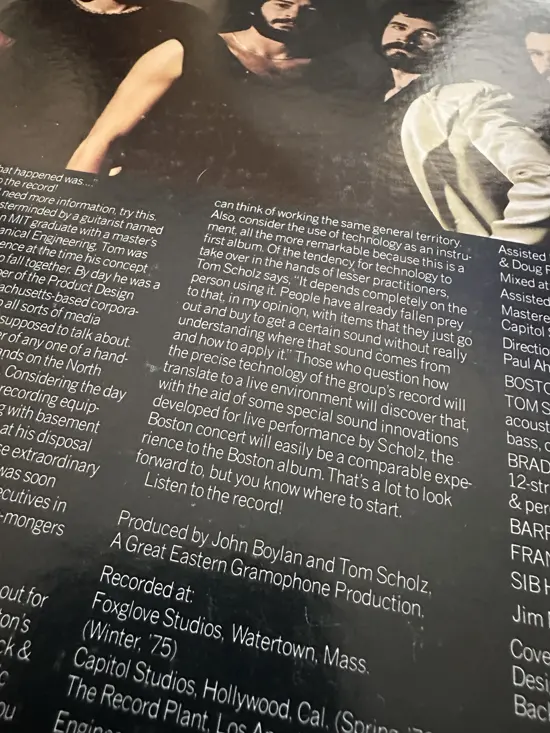 I was in a record store in Omaha when I was 12, reading the back cover of the first Boston album. Tom Scholz – MIT grad, genius engineer – said "Technology MUST serve the music. Not the other way around."
Tom was a decade ahead of everyone else technically, but what you heard on his record was just epic music. The technology was invisible. When you play Boston today, it still sounds fresh and alive – in sharp contrast to a lot of 1980s pop that's as out of date as the mullet haircuts. Boston's technology was in service of something that mattered.
Creating enduring work is an art form. We are very good at that here. 80/20 Sales and Marketing is more essential today than it was in 2013. Detox Declutter Dominate is TWICE as effective now as it was in 2020.
This is how I want our members to relate to tech. NOT chasing the latest tool for the sake of the tool. Not swept up in the hype, or paralyzed by the overwhelm. But understanding clearly what the tools can do – and grounding "flash in the pan,” ever-changing technology in principles that don't change.
80/20 doesn't change. Network Effect doesn't change. Star Principle doesn't change. Renaissance Time – protecting your space to think, to create, to see what's really happening – doesn't change. Those are not techniques. They are descriptions of reality. And they are more true today, not less.
But you have to step off the sidelines and get in the arena. Apply these tools to your hardest problems. Let yourself be surprised by what they can do. Then bring the judgment – yours, not the AI's – to point them at something that actually matters.
If you're already doing that: welcome. This is going to be one of the most interesting periods of your life.
If you're not yet: there is still time. But not unlimited time.
That's exactly why we built RenAIssance OS.
Renaissance AI is a founder community and operating system for the AI era. Not a course or a content library. It's the room I've been describing throughout this letter – where founders stop reacting to the market and start architecting it. Where you make the shift from running a business to operating a thinking system that runs your business.
I've spent 25 years building frameworks, courses, books, and private correspondence that most people never fully access – not because they're lazy, but because they're drowning, and don't know where to start.
SuperConductor is trained on all of it. Not the public version of my thinking. The deep version. The version that connects your specific situation to the right framework at the right moment, in a conversation that moves at speed no human coaching session ever could.
One client told me after his first session: "You're not selling me access to your work. You're selling me access to the version of your work that I'll actually use."
That's it exactly.
Most entrepreneurs are leaking tens of thousands of dollars a year – not from bad tactics, but from working on the wrong problems entirely. SuperConductor is built to end that.
For $99 you activate the RenAIssance OS and get 30 days of full access – including SuperConductor, the AI thinking partner that helped Jeff Coleman nail his competitive angle in 12 minutes, helped Robert Skrob transcend problems he'd been patching for years, and made a founder in an old-school industry say "How does it know things about our business that we haven't even articulated to each other yet?"
During that month, you begin installing the system into your actual business and workflow. After 30 days, membership continues at $199/month – ongoing access to SuperConductor, new AI lenses as we develop them, Circle community discussions 24/7, office hours, and the frameworks I've built over twenty years for leverage and clarity.
You also get the New Renaissance paper and ink newsletter delivered physically to your door.
The goal isn't learning AI tools. It's becoming the kind of founder who sees the game clearly and designs better businesses.
PROMISE: If you engage in RenAIssance OS for 30 days and are not slack jawed at the insights you get from SuperConductor and the SuperConductor and RenAI Circle Community… if it doesn't rank as the best help you've gotten anywhere, ask for a refund and you'll cheerfully get it.
Before you close this letter, think of one person.
Someone smart. Someone who works hard and has built something valuable. Who has that look lately – like they're paddling harder but not getting anywhere, and they can't put their finger on why.
They probably haven't sent you an email about it. They probably haven't told their spouse. They're just quietly carrying it.
Send them this letter. Not as a warning. As a gift.

Perry Marshall
- Robert Skrob
Be Unleavable, LLC
details and faqs
Yes, and here's the good news: we've made it easy. As a current R12 member, you can move to RenAIssance OS for $999 and get SuperConductor plus 6 months of full RenAIssance OS membership—including the Circle community and all RenAI calls. You keep your newsletter and Memos calls throughout. After your 6 months, membership continues at $199/month.
If you prefer to simply renew R12 as-is, you can absolutely do that. You'll keep the newsletter, Memos calls, and discounts. Just be aware that the program is changing: the annual renewal bonus course is no longer offered—we've moved beyond courses entirely and into proprietary custom GPTs, which are considerably more powerful. The webinars and other member benefits are also being phased out as our energy goes into Renaissance OS.
The Google Group remains accessible, but the action has moved to the Circle community inside RenAIssance OS—that's where the conversations, the office hours, and the real momentum are happening.
For most R12 members, the $999 bridge offer is the natural next step. It's the best entry point we offer, designed specifically for people who've already been in our world.