Last Photos & Tales from my 28,000 Mile Adventure
No Place Like Home
by Perry Marshall, September 16 ’04
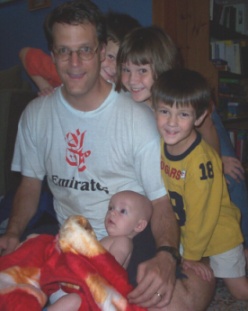
Man, was I ever happy to finally get home last night. Laura and Zander were waiting for me at the airport, and the kids made a “Welcome Home” sign for me.
My last email from Kenya was sent from a cybercafe where 12 computers were sharing a 56K modem. Uploading photos? Not a chance.
So today I’ll give you some of those photos and a few more valuable angles that apply to YOUR business, whatever you happen to be doing.
Investment Lesson from Rural Kenya
It’s nice to be charitable, and in fact it’s necessary – especially for children. However in the grand scheme of things, the only thing that gets people out of poverty is success in business. So I was extremely interested in George Karanga’s “Micro Enterprise” efforts.
In the last 2 years, George has provided grants of $50 to $150 to 15 different people, to help them start small businesses in Kenya.
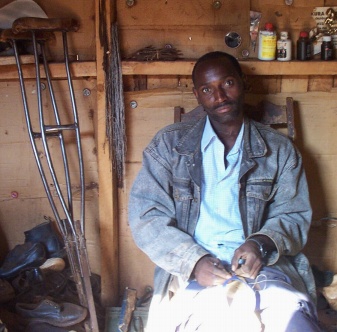
Out of 15 startups, 13 of those businesses have succeeded. That’s better than 85%!
With a track record like that – if George was an investment banker in the US, he’d be a rich man, doncha think?
This is a guy named Paul Mungai. As you can see here, Paul needs crutches to walk, but ironically, he’s a shoe repairman. Runs a cobbler shop. Paul started his business with $50 of seed money from George Karanga and his shop is doing well. The business has furnished a home and education for his kids.
All of these businesses are very simple: Cobbler, several fruit & vegetable stands, a tailor, tiny retail businesses that satisfy basic needs. $50 might not sound like much, but in a place where many people only earn a dollar or two a day, $50 is all the capital that’s necessary to get a new business off the ground.
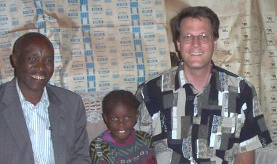
On the right is George Karanga, Lucy Njoki (9 years old) and me, smiling for the camera. Lucy is HIV positive, and in fact when relatives found out about it, they panicked and threw her and her mother out of the house.
But a sponsor has been found, she’s receiving retro-viral treatments and is in fine health. You’d never know unless someone told you.
Peter Githiri hasn’t been so fortunate. His stomach is swollen because of parasites, he appears to have a cold (very bad for someone with AIDS) and his hair is kind of crusty. Sad shape.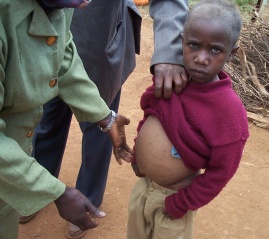
George says to me “Unfortunately a sponsor hasn’t been found for him.” I kept having to remind myself that I wasn’t watching TV, that George wasn’t telling me this just for ‘dramatic effect,’ and this situation was just as bad as it appeared, if not actually worse.
Now there are plenty of agencies and such who will show you this kind of stuff on depressing TV commercials, and unfortunately it’s not that unusual for most of the money to get siphoned off into some corporation.
The United Nations is allegedly concerned with problems such as this, but most of their time is spent on lavish breakfast meetings in New York and self-congratulation. Remember, the UN has Libya in charge of the “human rights” committee. Don’t expect any serious solutions from that crowd anytime soon.
In my mind, the UN is the political equivalent of a New York Advertising Agency: No concern for the measurable effectiveness of the client’s money; their primary concern is winning awards and attending exclusive dinner parties.
Such is the folly of assigning the care of the third world to Large Institutions. The hand that feeds is cold and impersonal and ever distracted by political interests.
That’s why I was so impressed with George and Jane Karanga. They live in the community with these people. They know who’s telling them the truth and who’s not. They know who really needs help and who doesn’t. They have a pretty good idea who’s going to be successful in a Micro Enterprise and who won’t, and what service the new business should be providing.
The thing that hit me Straight Between the Eyes
The conversation that hit me the straight between the eyes was when George told me about all the people who are NOT part of the sponsorship program, who ask them for help. Maybe they’ve run out of food. Maybe they need a $1.00 bus ticket to get some medical care. Maybe they’re looking for some temporary work to earn some money. Well if they want to help that person, they have to pull that money out of their own pockets.
And when they’re out of money, they’re out. George and Jane are not rich, they’re just ordinary Africans. Sometimes they just have to turn people away. But every penny they can spare goes back into their community.
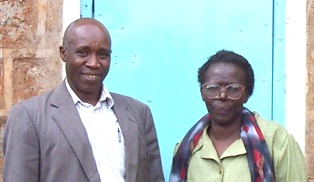
You can buy someone’s hands, but you can’t buy their heart. George and Jane’s hearts are in this and they’re deeply concerned about bottom-line results. George is really an entrepreneur, applying his heart, his ingenuity and his prayers to a cause that’s very personal for him.
That’s why he’s been so successful in supporting AIDS orphans and in starting Micro Enterprises. I went there and saw for myself something that larger institutions can rarely replicate.
I see the exact same thing mirrored in American business: The difference between the corporate drone and the enthusiastic entrepreneur. There are many people who dispassionately labor in Dilbert Cubes, having never gotten to the “bottom” of anything. They don’t understand cause and effect, and they’ve never put their own money on the line for any venture. They don’t get it.
MBA’s with a theoretical education and no practial experience doing anything join consulting firms and pretend to dispense good advice on how businesses should be run.
That’s where companies like Enron come from. And you should run away from such people. The real hero in business is the daring, street-savvy entrepreneur who puts his or her own nickels together, and with intimate knowledge of a customer, creates something new and valuable.
That’s the kind of business person you should invest in, and that’s the kind of charity you should invest in, too.
You too can Visit George Karanga
Unfortunately, some charities are non-profit equivalents of Enron. So you should always investigate the causes you give your money to. Good litmus test: Call them up and ask if you can go visit the people the money goes to. Do you get an invitation, or a run-around?
For me, this was a chance to do precisely that, and I was tremendously impressed.
If you’d like to visit George Karanga, you can. You can go to Nairobi, Kenya and see all this for yourself just like I did. If you’d like to do that, just call Alan Pieratt at (720)344-1940 and he can make arrangements for you. Alan is my brother-in-law and he manages Children’s Relief International (http://www.ChildrensRelief.org/) which is a small 501C3 tax exempt relief agency based in Texas. They send teams to Kenya several times a year and I can promise you this: You’ll never see the world the same way again, because you’ll fall in love with the people you meet there in Africa.
Some Final Thoughts About Traveling Abroad
Trips like the one you’ve been reading about always have a lasting effect on me. Every time I return from a trip like this, my brain goes into overdrive, processing all the sights and sounds and shifting perspectives. For about a week after I come back, I have vivid dreams as my mind tries to absorb the experience. And I never forget the people I’ve met and the conversations I’ve had.
Recommended Reading
Africa is truly an enigma to the Western mind. Well if there  was ever any such thing as a book that “explains Africa” it’s The Shadow of the Sun by Ryszard Kapuscinski. The author was the Africa correspondent for a Polish news agency for 30 years and he traveled all over the continent for three decades. The book is a beautifully written, beguiling montage of stories from almost every country in Africa, from the strange and cruel to the exotic and sublime.
One of the best travel books I’ve ever read is Falling Off the Map: Some Lonely Places of the World by Pico Iyer. It’s a tour of some of the most remote and forgotten countries in the world: North Korea, Cuba, Argentina, Bhutan, Iceland and Paraguay. I read this book 3 or 4 years ago and it inspired me to wander ‘off the beaten track’ in my quest for adventure.
Most of us may never manage to go to such strange and exotic locations as the ones Iyer writes about. Family obligations, schedules and finances all come into play. So I hope you’ll pick up one or both of these books and at least be taken away in the landscape of your own mind.
“I Have A Dream”
One last thought before I go.
There are some things that are impossible to grasp without seeing them for yourself first hand.
You can’t understand the joy of giving birth to a baby and the miracle of life until you’ve been there yourself and held a new son or daughter in your arms.
You can’t understand the energy and intensity of a live football or basketball game unless you’re right there in the stands cheering in triple overtime.
And you can’t understand the Third World unless you’ve seen it for yourself.
My first trip to such a place was five years ago in Sao Paulo, Brazil. It radically changed my perspective on everything. It permanently installed a sense of both gratitude for what I have, and a sense that I am, in fact, my brother’s keeper. I do have a responsibility to help when and where I can.
So I have a dream. Maybe this sounds silly, perhaps unrealistic. But my dream is this:
What if everyone who can afford to take a nice vacation – who can afford to go to Disneyland or take a cruise or whatever – what if everyone who has the means to do that went to Africa, just once?
What if everyone who has the means to do so went and visited a couple like George and Jane Karanga?
How would the world be different?
Indeed, the world would never be the same.
I don’t have the ear of the whole world, but I have your ear right now. And I would like you to promise yourself that at least one time in your life, you’ll go to a forgotten corner of the world. Maybe a far-away place like Africa. Maybe somewhere closer, like Mexico or Haiti. Heck, maybe all you can do right now is visit a women’s shelter or soup kitchen. But you can do something.
I have a dream. I hope you will share in it.
Thanks for coming joining me for this tour of the world. After coming all around the world, through Fiji, Australia, Malaysia, Singapore, United Arab Emirates, Kenya and Great Britain, I’m ready to stay home for awhile and play with my kids. And get back to work – there’s LOTS of things yet undone!
Take Care and God Bless.
Sincerely,
Perry Marshall
Finally home with the kids! And there’s Zander in his new blanket, a special gift to him from Jane Karanga.