
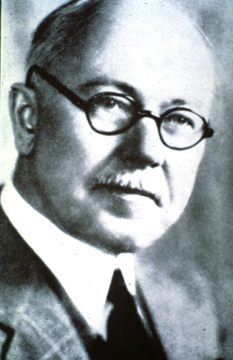
 AKA: A Rarely Discussed “Secret Weapon” Wielded by All True Masters of Every Discipline
Phil Alexander, who’s on my advisory board (not the guy in the picture), has one of the largest collections of rare marketing and advertising books in the world. If there’s a “historian” of the Information Marketing business, he’s it. People routinely pay Phil hundreds of dollars to find exceedingly rare, out-of-print books.
Phil made a very shrewd comment to me the other day: The people who are interested in these hoary texts are almost without exception the very best and brightest and highest paid in any profession. The casual worker bee, by contrast, isn’t all that interested.
For example: Phil and I went to a seminar in Orlando last April, and Phil had this old book from the 1920’s. There were two people who, without prompting, walked by, saw the book, picked it up and studied it with great interest. The two people were John Carlton and Scott Haines. John and Scott are two of the most successful, and highest paid, advertising copywriters in the country.
Coincidence? Not on your life. These guys are rabid consumers of everything they can get their hands on. And they’ll both tell you that the very best books on the subject of advertising were written almost 100 years ago.
In October I got another confirmation of this truth: I went to a presentation on audio power amplifier design at Crown International in Indiana. The speaker was Gerald Stanley, one of the most talented amplifier designers alive today. Crown is one of the largest companies in the business, and Mr. Stanley has been the genius behind Crown’s amplifiers for the last 30 years. About ten different times during his talk, Mr. Stanley referred to a book on amplifier design from 1931. He didn’t talk about very many other books or papers.
So what’s the significance of this? The author of the 1931 amplifier book did some truly original, groundbreaking work. He was a true genius. Most of the people who came after him were just copycats. Most of the other designs that came after were inferior derivatives of that original work. The fact is, truly groundbreaking discoveries are very rare and unusual. Those who make those discoveries usually aren’t coming up with new techniques – they’re identifying previously unknown principles.
Similarly, take someone like Claude Hopkins, author of Scientific Advertising, written in 1918. My late grandfather was only four years old when that book was written! Hopkins is the inventor of coupons, and he is one of the titans of advertising. And he’s ignored by most people in the ad business today, who are too busy doing stupid things to study the old masters. But you can take that book and apply it to Internet advertising in 2002 and you’ll be standing on solid rock.
I include his book with my system because it’s an early source and it is written from “first principles.” It truly lays down the essentials. A foundation built on this book is a foundation that will last.
People who are bona fide experts in a given field almost always approach things differently than everyone else. And they have an unusual ability to separate fact from fiction, to discern the difference between trends, fads and underlying truths. So like I always say, if you need a new idea, read an old book.
Share This Post
About the Author

Perry Marshall has launched two revolutions in sales and marketing. In Pay-Per-Click advertising, he pioneered best practices and wrote the world's best selling book on Google advertising. And he's driven the 80/20 Principle deeper than any other author, creating a new movement in business.
He is referenced across the Internet and by Harvard Business Review, The New York Times, INC and Forbes Magazine.
3 Comments on “True Experts, Original Sources, and First Principles”
It’s interesting that the old writings are the solid ones. So many modern readings are fluff, gimmicks, useless nonsense leading nowhere. A good reminder.
A valuable reminder about those who put forth the foundation that many follow today. Awesome read Perry.
I thank you very much your post sir Perry Marshal .. sure is very interesting for everyone