
Any business built exclusively on Social Media or Free Content or Free Traffic is a GALLEY SLAVE SHIP.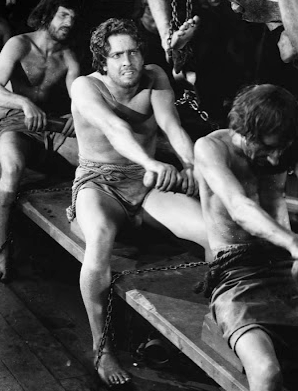
The common wisdom in Social Media is: Just generate lots and lots and lots of GREAT content and you will be popular and successful!
That is a LIE. It is not true.
Now Ariana Huffington got super rich on free content. And do you know how much she pays her bloggers?
ZERO.
I personally know six of them and none of them get paid a penny. Zilch.
Do you get it?
The chances of you building a big prosperous business exclusively on free content is about 1 in 10,000. And you will have your tongue hanging out your mouth if you pull it off.
All wrong.
The 80/20 way of Social Media is: The top 20% of the top 20% of your content – the 4% that is REALLY GOOD – you PAY to promote it and you use it over and over and over and over again for the endless passing parade of millions of people out there.
And then you get them into a sales funnel and you sell them.
You put a dollar in and you get two dollars out.
Anybody who tells you that a real business is anything other than putting a dollar in and getting two dollars out has no idea what a “real” business actually is.
Perry Marshall
Photo is from the movie “Ben Hur.”
Share This Post
About the Author

Perry Marshall has launched two revolutions in sales and marketing. In Pay-Per-Click advertising, he pioneered best practices and wrote the world's best selling book on Google advertising. And he's driven the 80/20 Principle deeper than any other author, creating a new movement in business.
He is referenced across the Internet and by Harvard Business Review, The New York Times, INC and Forbes Magazine.
5 Comments on “The Social Media Free Traffic Galley Ship”
An alternative title for this could be, “There’s No Such Thing as a Free Lunch”! Something that is often forgotten.
Thanks again for insightful writing.
Hey Perry,
I don’t know if you have heard of ‘Benford’s Law’, it looks very similar the 80/20 rule:
“Benford’s Law, also called the First-Digit Law, refers to the frequency distribution of digits in many real-life sources of data. In this distribution, the number 1 occurs as the leading digit about 30% of the time, while larger numbers occur in that position less frequently: 9 as the first digit less than 5% of the time.” wiki
“The discovery of Benford’s Law goes back to 1881, when the American astronomer Simon Newcomb noticed that in logarithm tables… the earlier pages (which contained numbers that started with 1 were much more worn than the other pages.”
80/20 seems to go back a long way, and turns up in the most unexpected places!
http://en.wikipedia.org/wiki/Benford's_law#History
Adam,
I ran the graphs side by side – of the Benford’s Law percentages plugged right into the 8020curve — and look, this is downright scary:
http://screencast.com/t/XUOQbbL2bby
(30.1%, 17.6% etc)
WOW!
The black is 80/20 curve theory, with the ratio set to 80:20 and the blue is the Benford’s Law numbers.
This seems significant:
“The precise form of Benford’s Law can be explained if one assumes that the mantissae of the logarithms of the numbers are uniformly distributed; and this is likely to be approximately true if the numbers range over several orders of magnitude. For many sets of numbers, especially sets that grow exponentially such as incomes and stock prices, this is a reasonable assumption.”
“Therefore, this is the distribution expected if the mantissae of the logarithms of the numbers (but not the numbers themselves) are uniformly and randomly distributed.”
Which is exactly the case with power law distributions.
The phenomenon was again noted in 1938 by the physicist Frank Benford,[1] who tested it on data from 20 different domains and was credited for it. His data set included the surface areas of 335 rivers, the sizes of 3259 US populations, 104 physical constants, 1800 molecular weights, 5000 entries from a mathematical handbook, 308 numbers contained in an issue of Reader’s Digest, the street addresses of the first 342 persons listed in American Men of Science and 418 death rates. The total number of observations used in the paper was 20,229.
The article talks about “scale invariance” – hey, that’s just another term for fractal.
“Some well-known infinite integer sequences provably satisfy Benford’s Law exactly (in the asymptotic limit as more and more terms of the sequence are included). Among these are the Fibonacci numbers,[29][30] the factorials,[31] the powers of 2,[32][33] and the powers of almost any other number.”
Yes, yes, yes.
Dang I love a great mastermind. Adam, you get a Planet Perry gold star for today!!! Bravo.
Hey Perry, was just on your Niche Expert Status page here: http://www.perrymarshall.com/celebrity/
The headline starts off: Are you’re sick of begging for Joint Ventures…
I believe you wanted to write, “Are “you” sick of…
Bye for now guys.
I could swear that sentence read just fine when we first put the page up. Well anyway thanks for letting us know our fly was down!