
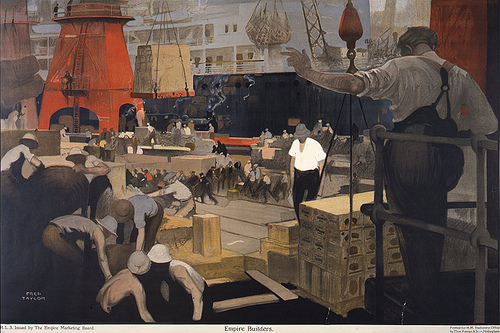
 Most sales managers are empire builders. Most corporate people are empire builders. But it’s a shocking experience when the empire comes crumbling down because it was built on a pile of false premises.
Look at Wall Street – posers get exposed every day. The economy tanks and everyone’s caught with their pants down. Why does it happen? It’s not because it has to be that way. It happens because people at companies like Enron, Worldcom, Andersen Consulting, Lehman Brothers, and AIG are obsessed with appearances, not reality.
When the economy is bad, there’s a Darwinian effect – the posers get stripped naked. But the businesses that truly serve people, the ones that are based on the “is” world instead of the “should be” world or the “looks good” world – they do just fine.
Re-Inventing an IT Business With a Killer Guarantee
Here’s an example. Ciro Cetrangolo started an Information Technology company here in Chicago. According to traditional wisdom, it was a very bad time to start an IT company.
And yes, the Ciscos and Nortels of the world were in the tank at the time, but the fact is, most IT customers aren’t in the IT business (duh). They’re butchers, bakers and candlestick makers. Which means that when companies moan about IT, it just doesn’t apply nearly as much as people think it does.
Most of our conversation was focused on a risk-reversing guarantee. We put the ideas together, then he used a consulting certificate to fine tune it. Here’s his guarantee:
Our Unique Support Guarantee:
Because our services are critical to the companies and people we service, we do more than make promises. We live up to them. The only way we can prosper is by helping you succeed.
So here’s what happened: He sent me this email:
Dear Perry:
As you know I bought the kit ($1000.00), I did the USP and the guarantee with your guidance and assistance, as I was still working on the letters, web site, white paper/report etc, etc, I sent out just my USP and Guarantee on real nice paper, one on one side, one on the back, to people I had done quotes for before but not business with, basically people I had lost business to before.
About 15-30 of them total postage:$12.00. One of them called me and said he wanted a network review, I again used what I had learned from you and told him I could do that, and I charge $250.00 for a network evaluation and upgrade strategy planning. He accepted it, and I did it for him, telling him during the review of this that he can bid it out, etc, etc using my plan as an RFP. He said, basically referring to my guarantee, that “You’re the first guy/company that really understands customer service and standing behind your products and service, that’s something I’ve never seen in all my years dealing with you guys.”
He went on to tell me I didn’t have any competition and that I could book the dates for the install. (And I later got a check – that’s my own policy from previous experience). About $30,000 in business. Total Investment: $1012.00, not too bad.
Ciro
OK, so what’s the difference between Ciro and all of the other IT consultants out there? Let’s assume that they know just as much about installing computers and networks as he does. He’s got a significant advantage on a couple of major fronts:
1.) Ciro talks to people in plain English. This is very, very important. Open the Yellow Pages (if you can find one anymore) and look up Information Technology. What do you see? A bunch of techno-Latin about MCSE certification, a bunch of big-company logos, and a forewarning that the guy who shows up to fix your server is going to have a surly, holier-than-thou attitude and speak a foreign language.
2.) Ciro takes on the risk. This is real important. Last week I talked to a guy who works for a major robotics company. In his business, if he gets a contract, he is going to make the equipment work, come heck or high water, because he couldn’t possibly afford the black eye he’d get if everyone found out that his company screwed up the installation at a new General Motors plant. But this is a big corporation and the big company won’t state any guarantees up front. They’re going to have to support this anyway – so why not guarantee it at the outset? In Ciro’s case, the customer’s experience is not that much different than a car repair: You don’t want to pay for them to figure it out twice or three times. Ciro guarantees that they won’t. Also note that having a guarantee prevents you from taking on projects that you really shouldn’t take. It serves as a sanity check so that people you can’t help don’t give you their money.
3.) His “President Direct” guarantee assures people that if push ever comes to shove, they’ll get a real human being who’ll take action – not a voice mailbox. That’s enormously appealing.
4.) He’s got a lead generation system put together (barely had time to implement it, since his hands are full with new business) so that he can always turn on the spigot and get new customers at will.
Add these together and you’ve got a killer proposition that’s head and shoulders above everyone else.
Ciro is recession-proof.
You can be, too.
Photo by: The National Archives UK cc by-sa
Share This Post
About the Author

Perry Marshall has launched two revolutions in sales and marketing. In Pay-Per-Click advertising, he pioneered best practices and wrote the world's best selling book on Google advertising. And he's driven the 80/20 Principle deeper than any other author, creating a new movement in business.
He is referenced across the Internet and by Harvard Business Review, The New York Times, INC and Forbes Magazine.
2 Comments on “Building an Empire Vs. Building a Business to Support Your Lifestyle!”
Hi Perry,
I’m in Internet marketing and our clients hire us to get them more leads, business, etc., primarily from PPC and local SEO. You know as well as I do that providing a performance guarantee is tricky because we control only a portion of the value chain. Any suggestions on how to reverse the risk of our clients (short of using performance based pricing)?
“If you do X according to Y specifications and we do Z and you do not get [RESULT] then [PENALTY TO ME]”
You deciding, defining and communicating X and Y is super critical and will hugely clarify everything for everybody.