
Please indulge me in a few moments of pure, unadulterated Geek-ness as I attempt to convey a profoundly important life lesson.
In this month’s Renaissance Club Newsletter, which just hit the streets, I said:
All great truths can be expressed simply enough to be understood by children.
If somebody’s “Great Truth” cannot possibly be explained to a child it’s not a Great Truth. It’s probably a Minor Truth, or worse yet, an outright con.
OK, so here’s an uber-geek version of this.
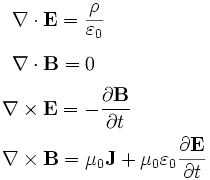
What you see here is what engineers and physicists affectionately call “Maxwell’s Equations.”
Please just forget for a moment that you and most people may not have any idea what this actually says or means. That’s fine. You don’t have to, to 100% understand what I’m trying to convey.
What I want you to do is simply take a look at these four equations for a moment. Do you recognize a certain amount of art here? An odd sort of geeky beauty and symmetry? Two of these equations are about “E”, two are about “B”, two have a dot and two have a cross. One equals zero and the others equal something else.
Well the cool geeky thing is, these four equations tell you almost everything you could possibly want to know about light, electricity and magnetism.
A person who speaks the calculus lingo at a “sixth grade” level would recognize that this is the simplest possible way to describe electrical fields (“E”) and magnetic fields (“B”). It actually describes them completely. And honestly, it is actually possible to explain, conceptually, what these formulas mean to a sixth grader. Even if he or she doesn’t know the math.
And even if you don’t understand something at first, you hope it will be useful and elegant, right? It should be expressed in simple terms without a big long convoluted explanation.
(If you’d like to read a relatively simple explanation of Maxwell’s equations, you can get it here.)
Early in his career, Einstein came to realize that if a math formula was true, he expected it to also be beautiful. The ultimate example being E=mc?. A math formula 12 miles long is most definitely not elegant and is probably not even useful.
Now the thing about Maxwell’s equations is, you can expand them out to mind-boggling complexity without even trying very hard.
But mind-boggling complexity is not what makes things work. SIMPLICITY is.
Einstein said: “Make everything as simple as possible, but not simpler.”
In marketing, complexity per se is fine. The more complex your sales funnel is, the harder you are to knock off.
But at the root of even the most complex marketing machine should be a few simple principles that define and explain everything you do. I have a huge website and miles of autoresponders but they exist for pretty simple reasons, and to accomplish pretty simple goals.
The Tactical Triangle is the ultimate simplification, reducing marketing to just four elements: Traffic, Conversion, Economics, and 80/20. No matter what you’re doing, the thing you need to do next revolves around one of those four things.
Truth is beautiful. Simplicity is beautiful.
One last thing:
In your life you will encounter people who are enamored with complexity. They think it’s some kind of virtue. They impress you with their Wharton MBA’s and their techno-latin. But mostly it’s just jargon. They don’t truly and deeply understand what they’re saying. And they don’t embrace simplicity. They actually sneer at it. They babble a lot.
Whenever you encounter those people, RUN the other way. They just create unnecessary work for other people. They pile band-aids on top of band-aids. Those are the people who ram 2,457 page bills through Congress. They are the entrepreneur’s worst enemy.
Eventually those guys get old and become bureaucrats. They start companies like Enron, where everybody assumes the guy one cubicle over understands how this whole thang works. And actually nobody does.
Confusion is ugly.
Embrace simplicity. Invite it, court it, study it, admire it, and reward it. For it will reward you.
Perry Marshall
Share This Post
About the Author

Perry Marshall has launched two revolutions in sales and marketing. In Pay-Per-Click advertising, he pioneered best practices and wrote the world's best selling book on Google advertising. And he's driven the 80/20 Principle deeper than any other author, creating a new movement in business.
He is referenced across the Internet and by Harvard Business Review, The New York Times, INC and Forbes Magazine.
5 Comments on “Truth is Beautiful. Confusion is Ugly.”
Hi Perry,
What would you say to Alfred North Whitehead who once famously said “Seek Simplicity and learn to distrust it”.
Many people (in advertising, sales, software folks) leave and die entirely in the world of simplicity.
simplicity is good to understand things but in order to get deeper understanding – you need to leave the sheild of simplicity and embrace complexity, pluralism and infinite complex world around us.
Feynman learned all through the world complexity and on getting to the bottom of his journey – he presented what he learned in “simple terms” – things he studied were very very complex and counter-intuitive.
What do you say?
I think many people live and die entirely in the world of complexity.
Complexity is only the outworking of simple patterns combining over time.
All the laws of physics written out would only take a few pages.
There is a quote I have always loved by the physicist Richard Feynman:
“You can recognize truth by its beauty and simplicity. When you get it right, it is obvious that it is right — at least if you have any experience — because usually what happens is that more comes out than goes in . . . . The inexperienced, the crackpots, and people like that, make guesses that are simple, but you can immediately see that they are wrong, so that does not count. Others, the inexperienced students, makes guesses that are very complicated, and it sort of looks as if it is all right, but I know it is not true because the truth always turns out to be simpler than you thought.”
Enjoy,
GARRY
Yessir! I love Feynman.
My favorite Feynman-ism: “Why does a piano smash when it hits the sidewalk?”
Thank you for the great reminder about what truly works in life — simplicity. I do look forward to your daily messages.